
The strongest piece of proof offered in this Judge Judy segment is a store manager's name, and nobody in the courtroom has picked up a phone to call him. That offer, made in a single breath, is the only claim in the room that someone outside the room can check. Everything else in this Judge Judy chapter rests on memory, volume and paperwork nobody brought.
The one call that could settle it
The offer comes out whole and unprompted. “So if you call, if you call right now, the store manager's name's on there. And he's willing to tell you that she reported all this stolen a long time ago.” It is answered with two words — “Yeah, exactly” — and then the Judge Judy argument moves on, as it always does here, to something louder.
It is worth slowing down on what was just said, because a named witness is a different category of evidence from everything else this case has produced. A bill of sale proves that somebody bought something. A receipt proves how much it cost and where. Neither document has appeared in this Judge Judy round.
What has appeared, round after round, is a witness willing to be named. In small-claims court, where the disputed amounts are usually small enough that hiring a lawyer would cost more than the claim, that distinction matters enormously. A judge can weigh a receipt in a drawer. A judge can also pick up a phone, and a third party who agrees in advance to confirm a fact beats any document nobody thought to bring.

The underlying claim is not new to this Judge Judy case. Earlier testimony held that a television, a VCR and a stereo had been reported stolen three years before, and that a store called Renaissance Center would confirm it. What is new is the specificity: a name, on a record, and a stated willingness to say the items were reported stolen “a long time ago.”
The documentation problem has dogged this Judge Judy case from the start. No bill, no receipt and no buyer's name has surfaced for the three entertainment centers, the couches or the stereo. That problem suddenly has a possible answer sitting one phone call away. It is just not an answer that lives in the room.
Three months of knowing each other
The very next line in this Judge Judy round shrinks everybody's authority to testify about anybody. “I've only known these people for like three months,” one voice says, and a second voice answers with a flat “Yeah.” That admission lands moments after a name has been offered as proof, and it changes how the offer should be read.
Take the three months seriously rather than as filler. Three months is shorter than the three years that have passed since the theft report was supposedly filed. It is shorter than the life of a couch, an entertainment center or a stereo, and shorter than the history being argued here. If the people at these tables met roughly a season ago, none of them can honestly describe a sale they did not attend.
That is exactly why the Judge Judy conversation keeps sliding off memory and back onto store records, police reports and named managers. The room has no firsthand witness to offer, so it keeps reaching for paperwork instead. The three-month admission also reframes the volume. Somebody who has known the others for three months is not defending a long friendship but a version of events picked up secondhand.
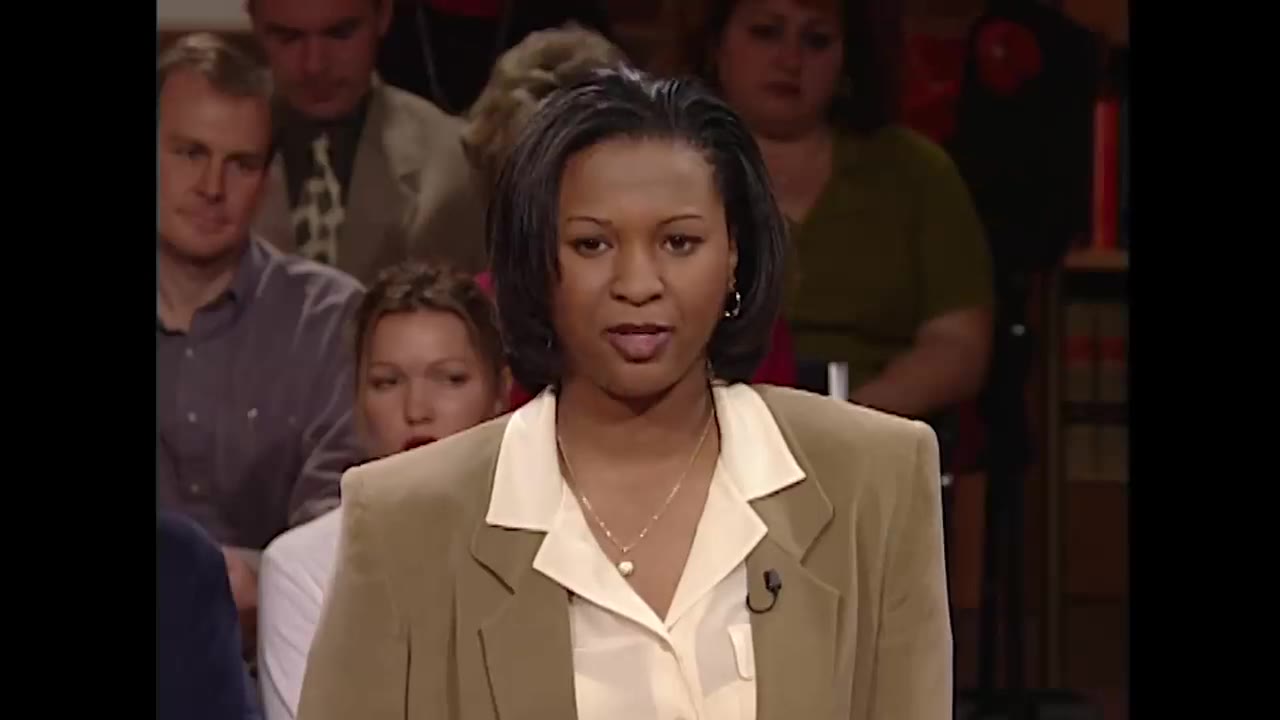
The tattoo on his chest
Then the Judge Judy case changes key entirely. “If he loved her so much, why did he have my name tattooed on his chest?” That question is the emotional centre of this chapter's argument, and it is built as evidence rather than feeling. A tattoo is permanent, deliberate, paid for and carried on the body.
In a round where nothing has been produced on paper, a mark on a man's chest is offered as the one physical exhibit that cannot be misplaced in a drawer. The question frames that mark as proof against a professed love. Whether a tattoo can carry that weight is a separate question, and nobody in this Judge Judy segment tests it.



Comments 0